
Research
The EU AI Act Does Not Count Pixels
Does your AI-generated product image need a label?
- Sourceful Research
- AI
- Ecommerce
- Marketing
- Compliance

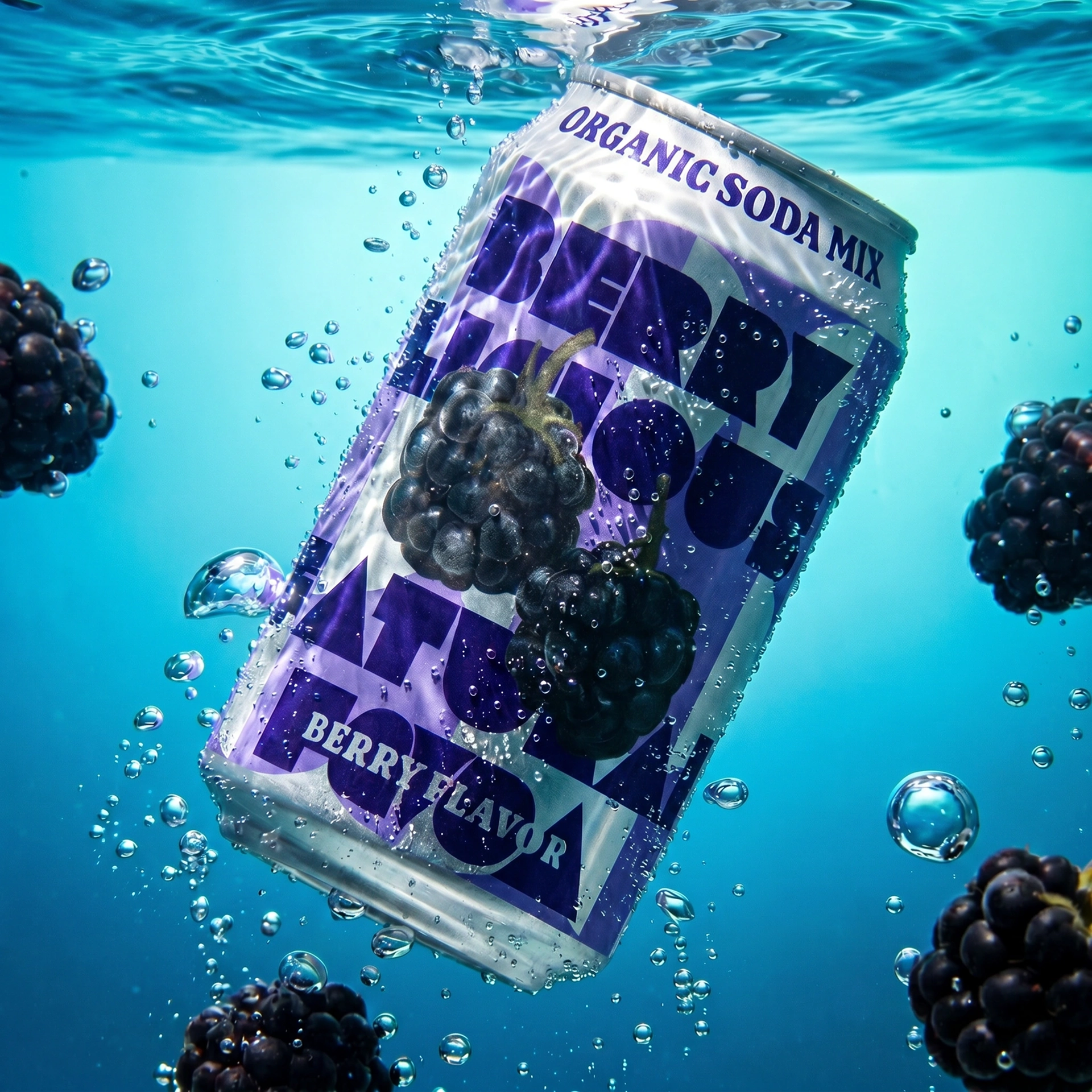
Article 50 of the EU AI Act became applicable on 2 August 2026. In this article, we investigate the practicalities of complying with it in a world where more and more media assets are created with AI assistance. Let's say you photograph a real bottle of shampoo. Then an AI tool removes a speck of dust, extends the background, adds a shadow and places the bottle on a marble counter overlooking the Mediterranean.
Would this be classified as an “AI image”? Do you need to stamp AI-GENERATED across the advertisement to comply with the EU AI Act?
Actually, no.
Article 50 of the EU AI Act, active since 2 August 2026, does not set a threshold based on how many pixels AI changed or if AI was used at all. When deciding whether customers need a visible label, the key test is about whether the finished content:
Could someone mistake something synthetic for a real person, product, place or event? Would that affect what they believe?
The Act’s definition of a “deepfake” goes beyond the celebrity face swaps most people associate with the term. It can include realistic AI-generated or manipulated people, products, places and events that falsely appear authentic or truthful.
Protect the truth about your product. Be creative around it.
Think of a product image as two things.
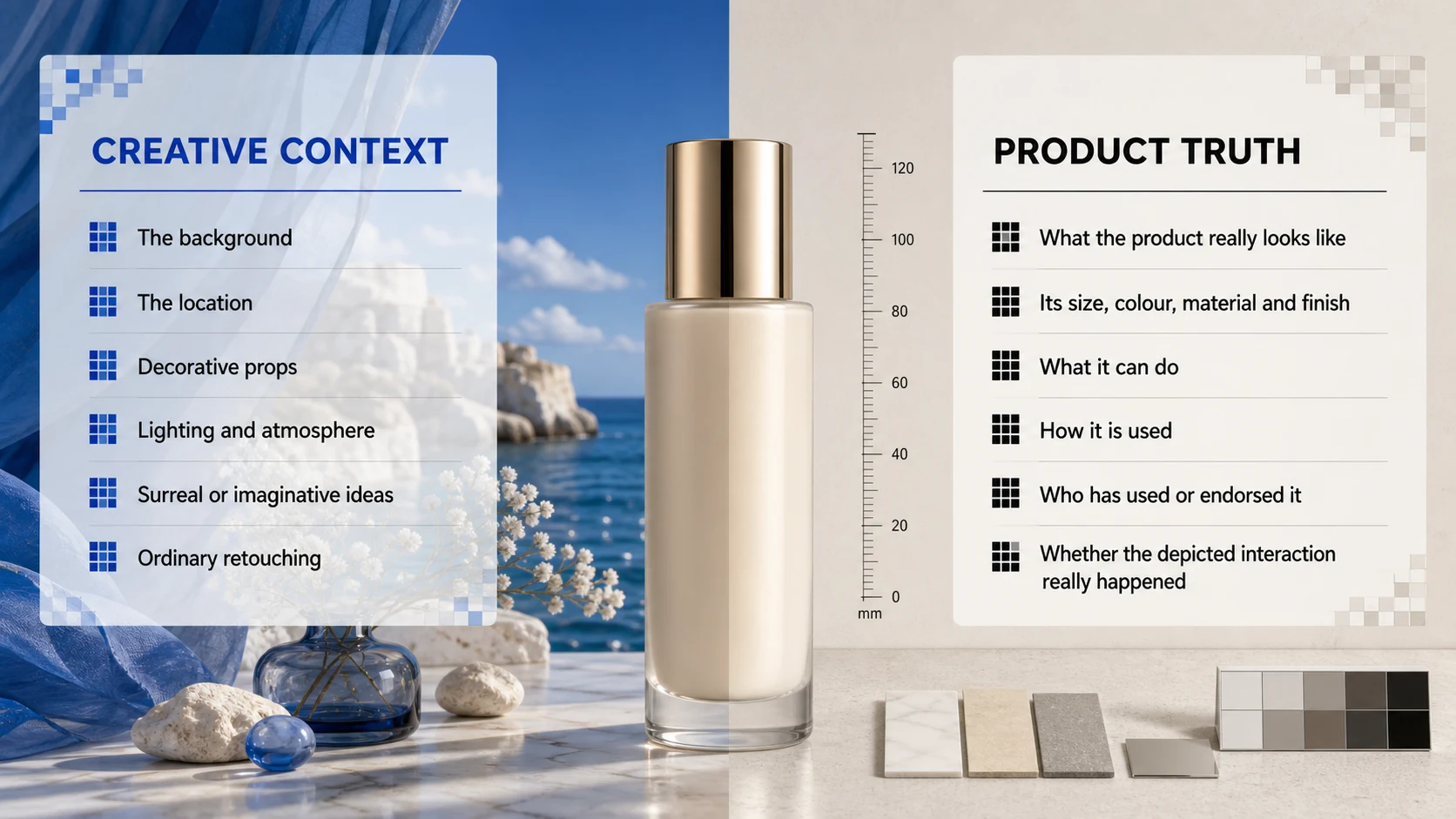
Creative context includes:
- The background
- The location
- Decorative props
- Lighting and atmosphere
- Surreal or imaginative ideas
- Ordinary retouching
Product truth covers:
- What the product really looks like
- Its size, colour, material and finish
- What it can do
- How it is used
- Who has used or endorsed it
- Whether the depicted interaction really happened

Brands have plenty of creative freedom within these guidelines to invent and innovate the setting. But more care is needed when AI quietly changes product truth in a way that could mislead viewers.
A real product can appear in a fully generated world without automatically needing a visible AI label. A small edit to the product itself—especially its claims—may require disclosure if it changes what customers believe about its appearance, quality or use.
A large amount of AI may create no misleading impression. A tiny AI edit can create one.
Do not confuse technical marking with a visible label
Article 50 separates machine-readable marking from disclosure that people can see. The two are often lumped together.
Machine-readable marking
Providers of AI systems that generate or manipulate images, video, audio or text generally need to make those outputs detectable in machine-readable form. They may use metadata, provenance information, watermarks, fingerprints or other technical methods.
Customers may never see this marking. Software reads it.
Riverflow images and videos carry this machine-readable marking in compliance with this requirement.
Minor, non-substantive edits can fall outside the requirement. The Commission’s examples include small crops, colour corrections, sharpening, dust removal, noise reduction and certain forms of pixel filling. The Commission’s Article 50 guidance explains the distinction between standard editing and generative or manipulative output.
Visible disclosure
A brand, agency or other professional user has a separate obligation to disclose AI-generated or manipulated image, video or audio content when the result constitutes a deepfake.
For most ecommerce and marketing teams, this is the practical question:
Does the customer need to see a label on this asset?
Not always.
Seven common marketing examples
| Content | Visible label? | Why |
|---|---|---|
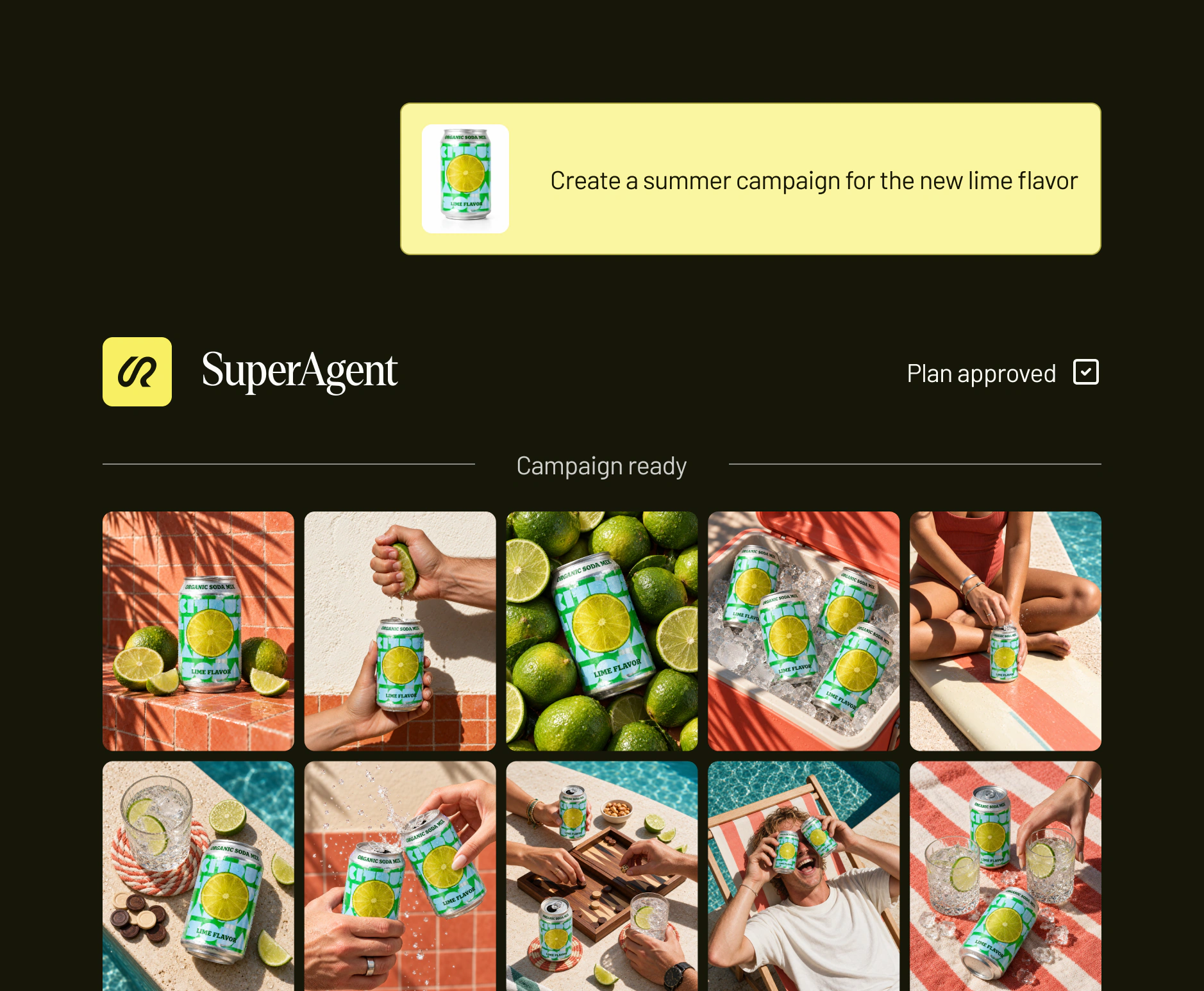
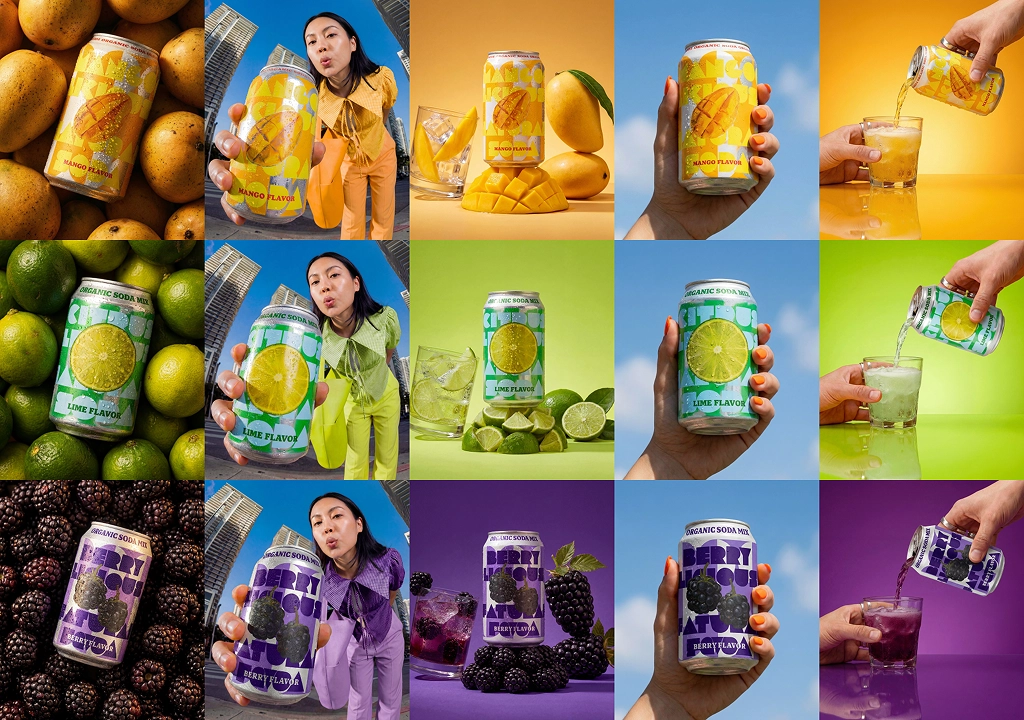
| A real product on an AI-generated background | Usually no | The product remains authentic. The generated setting is creative context. |
| AI removes dust, corrects colour or extends the edge of a background | Usually no | These are generally minor or technical edits. |
| Existing real products are arranged into a new aesthetic composition | Usually no | The composition changes; the products do not. |
| AI makes the product larger, shinier, better fitting or more luxurious than reality | Likely yes | The image may mislead customers about the real product. |
| A real model is shown holding a product that was generated into their hand | Depends on context | Is it a real product being displayed accurately with the model's knowledge? |
| A realistic synthetic influencer demonstrates a product | Yes, in most ordinary advertising contexts | The person and demonstration appear real. |
| Talking mice argue about cheese in an obviously fantastical advert | Usually no deepfake label | Viewers are unlikely to believe the event really happened. |
The European Commission gives a concrete example for product advertising: a real car shown against an AI-generated background does not constitute a deepfake if the advertisement is unlikely to mislead people about the car’s real appearance, characteristics or use. It also treats aesthetic background changes, product compositions and image rescaling as having only a minor effect on perceived authenticity.
Change the product itself and the answer can flip. The Commission treats AI-generated product imagery as a deepfake when it makes the item look different from the real product, more appealing or better quality than it is in real life.
Photoshop is not the test
Using Photoshop does not create an AI Act disclosure obligation by itself. Cropping, compositing, retouching and colour correction do not become generative AI merely because they happen on a computer or use a GPU.
An AI-powered Photoshop feature does not automatically require a visible label either. Ask what the edit changed.
Removing a passer-by from the background, correcting the lighting or extending an existing backdrop for aesthetic reasons will normally be treated differently from:
- Inserting a person who was never present
- Replacing one product with another
- Changing the shape or fit of a garment
- Generating a testimonial
- Fabricating a product demonstration
- Making packaging or food look materially better than reality
The tool does not decide the issue. What the finished image says does.
A real person holding an AI-generated product
Suppose you photograph a model posing with an empty hand and later generate the product into it.
That does not automatically make the finished image a deepfake.
Advertising is staged. A viewer seeing a model holding a shampoo bottle does not normally assume that the model personally uses the shampoo, or even that every part of the scene existed exactly as photographed.
The relevant question under Article 50 is whether the AI-generated or manipulated content would falsely appear authentic or truthful. The Commission says that assessment depends partly on the context in which the image appears and what its audience would reasonably expect to be authentic.
For an ordinary product advert, inserting an accurate product into a model’s hand may therefore be different from fabricating a genuine endorsement or real-world event.
Context can change the answer. Generating a particular product into the hand of a recognisable athlete, celebrity or customer may imply that the person actually appeared with or endorsed that product. A realistic image presented as documentary evidence of someone using a product would raise similar concerns.
What should the label say?
The Act does not require a long disclaimer, the model name or a breakdown of which pixels were generated.
The EU has created optional labels and icons that use two descriptions:
- Fully AI-generated
- Partially AI-modified


The icons are optional. The disclosure obligation, when it applies, is not. The Commission’s user testing found that the icons worked better with text. The EU icons for labelling AI-generated content are available from the Commission.
You can also say exactly what changed:
- “This image was partially modified using AI.”
- “This video contains AI-generated imagery.”
- “AI-generated product visualisation.”
- “Real photography with an AI-generated product.”
Do not rely only on AI-assisted, enhanced, virtual or a bare #AI. Those phrases say that technology was involved, but not that part of the content is synthetic.
Put the disclosure where people will see it
A required disclosure must be clear, distinguishable and available when someone first encounters the content. Do not bury it in terms and conditions, hide it behind several menu layers or place it where viewers are unlikely to notice.
Social posts and Meta ads: Use an immediately visible platform label or put the disclosure on the creative. Do not depend on a caption that may be collapsed or separated from the image.
Product detail pages: Put the disclosure on or directly beside the affected image or video, especially when customers can open the asset in a gallery.
Video: Disclose at the start. When people may encounter the video midway through autoplay or social scrolling, a persistent or repeated indicator is safer.
Downloaded and syndicated assets: Keep relevant provenance information and visible disclosure attached as the content moves between channels.
Do AI-written captions and product descriptions need labels?
Ordinary advertising copy and product descriptions generally fall outside the AI Act’s special visible-disclosure rule for public-interest text.
The Commission specifically lists AI-manipulated text used in company advertisements or product descriptions as outside that rule, except where it contains claims in areas such as health, consumer safety or sustainability.
That does not permit false claims. Advertising, consumer-protection and sector-specific rules still apply whether a person or an AI system wrote the words. A human should verify every factual product claim.
The five-step check before publishing
Whether you make an asset with AI from scratch or edit it in post, ask:
- Is the real product represented accurately?
- Did AI invent a person, interaction, endorsement or demonstration?
- Could someone reasonably believe the generated part really existed or happened?
- Does the background imply a factual claim about testing, performance, location or use?
- Where disclosure is needed, will the viewer notice it immediately?
The first question catches most ecommerce risk. Check the packaging, proportions, colour, materials, logos, text, ingredients, product quantity and functional details. An attractive image is no use if it shows the wrong product.
How we think about this at Riverflow
At Riverflow, we use one rule:
Protect the product. Free the setting.
We worked hard to build the best model layer and application layer for preserving product fidelity across artwork, structure, sizing and texture. This gives you greater confidence when moving at speed and scale.
AI should give brands more room to create, not force every asset to carry a warning sticker.
A team can photograph a real product once, then place it in dozens of imaginative environments. The background can change with the season, market or format, without a new physical shoot for every idea.
The product should remain faithful to reality unless it is obviously imaginative. A huge shampoo bottle in a bathtub, for example, is not misleading because it is clearly unrealistic.
When an asset moves from creative staging into a realistic synthetic claim—especially about a person, endorsement, demonstration or product characteristic—disclose it clearly.
The practical rule
The EU AI Act does not say:
“AI touched it, therefore label it.”
For marketing teams, a better rule is:
“Be creative about the world around the product. Be truthful about the product and what really happened.”
For enterprises looking to deploy generative AI in brand-safe environments, please contact us to discuss pricing and deployment.
This article provides general information based on the European Commission’s Article 50 guidance available in August 2026. It is not legal advice, and context-specific or regulated claims may require professional review.